Grammatik was the first grammar-checking program for home computers. Aspen Software of Albuquerque, NM, released the earliest version of this diction and style checker for personal computers. It was first released no later than 1981, and was inspired by the Writer's Workbench. Grammatik was first available for the TRS-80, and soon had versions for CP/M and the IBM PC. Reference Software International of San Francisco, California, acquired Grammatik in 1985. Development of Grammatik continued, and it became an actual grammar checker that could detect writing errors beyond simple style checking. Subsequent versions were released for MS-DOS, Windows, Macintosh, and Unix. Grammatik was ultimately acquired by WordPerfect Corporation and is integrated into the WordPerfect word processor.
Cognitive robotics
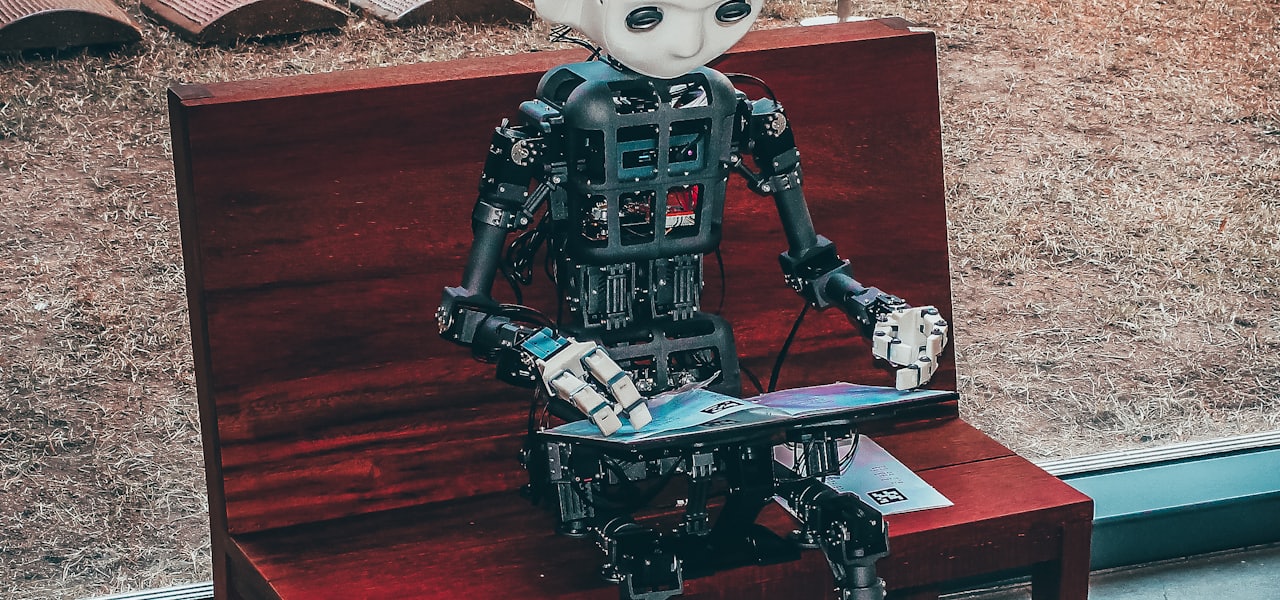
Cognitive robotics or cognitive technology is a subfield of robotics concerned with endowing a robot with intelligent behavior by providing it with a processing architecture that will allow it to learn and reason about how to behave in response to complex goals in a complex world. Cognitive robotics may be considered the engineering branch of embodied cognitive science and embodied embedded cognition, consisting of robotic process automation, artificial intelligence, machine learning, deep learning, optical character recognition, image processing, process mining, analytics, software development and system integration. == Core issues == While traditional cognitive modeling approaches have assumed symbolic coding schemes as a means for depicting the world, translating the world into these kinds of symbolic representations has proven to be problematic if not untenable. Perception and action and the notion of symbolic representation are therefore core issues to be addressed in cognitive robotics. == Starting point == Cognitive robotics views human or animal cognition as a starting point for the development of robotic information processing, as opposed to more traditional artificial intelligence techniques. Target robotic cognitive capabilities include perception processing, attention allocation, anticipation, planning, complex motor coordination, reasoning about other agents and perhaps even about their own mental states. Robotic cognition embodies the behavior of intelligent agents in the physical world (or a virtual world, in the case of simulated cognitive robotics). Ultimately, the robot must be able to act in the real world. == Learning techniques == === Motor Babble === A preliminary robot learning technique called motor babbling involves correlating pseudo-random complex motor movements by the robot with resulting visual and/or auditory feedback such that the robot may begin to expect a pattern of sensory feedback given a pattern of motor output. Desired sensory feedback may then be used to inform a motor control signal. This is thought to be analogous to how a baby learns to reach for objects or learns to produce speech sounds. For simpler robot systems, where, for instance, inverse kinematics may feasibly be used to transform anticipated feedback (desired motor result) into motor output, this step may be skipped. === Imitation === Once a robot can coordinate its motors to produce a desired result, the technique of learning by imitation may be used. The robot monitors the performance of another agent and then the robot tries to imitate that agent. It is often a challenge to transform imitation information from a complex scene into a desired motor result for the robot. Note that imitation is a high-level form of cognitive behavior and imitation is not necessarily required in a basic model of embodied animal cognition. === Knowledge acquisition === A more complex learning approach is "autonomous knowledge acquisition": the robot is left to explore the environment on its own. A system of goals and beliefs is typically assumed. A somewhat more directed mode of exploration can be achieved by "curiosity" algorithms, such as Intelligent Adaptive Curiosity or Category-Based Intrinsic Motivation. These algorithms generally involve breaking sensory input into a finite number of categories and assigning some sort of prediction system (such as an artificial neural network) to each. The prediction system keeps track of the error in its predictions over time. Reduction in prediction error is considered learning. The robot then preferentially explores categories in which it is learning (or reducing prediction error) the fastest. == Other architectures == Some researchers in cognitive robotics have tried using architectures such as (ACT-R and Soar (cognitive architecture)) as a basis of their cognitive robotics programs. These highly modular symbol-processing architectures have been used to simulate operator performance and human performance when modeling simplistic and symbolized laboratory data. The idea is to extend these architectures to handle real-world sensory input as that input continuously unfolds through time. What is needed is a way to somehow translate the world into a set of symbols and their relationships. == Questions == Some of the fundamental questions to be answered in cognitive robotics are: How much human programming should or can be involved to support the learning processes? How can one quantify progress? Some of the adopted ways are reward and punishment. But what kind of reward and what kind of punishment? In humans, when teaching a child, for example, the reward would be candy or some encouragement, and the punishment can take many forms. But what is an effective way with robots?
BeReal
BeReal (stylized on the app logo as BeReal.) is a French social-networking app released in 2020, developed by Alexis Barreyat and Kévin Perreau. Currently, it is owned by Voodoo. Its main feature is a daily notification that encourages users to share photos of themselves in their day-to-day life, on any randomly selected two-minute window every day. Critics noted its emphasis on authenticity, which some felt crossed the line into the mundane. The primary reference of its name relates to its focus on users uploading unpolished photos, with it being a pun of the term B-reel. According to the app's description on Apple's App Store, BeReal encourages its users to "show their friends who they really are, for once," by removing filters and opportunities to stage or edit photos. After a couple of years of relative obscurity, it rapidly gained popularity in early and mid-2022 growing from 21.6 million to 73.5 million users between July and August, before experiencing a decrease in use in 2023 and continuing to decline to 23 million users at the beginning of 2024. == History == The app was developed by Alexis Barreyat, a former employee at GoPro, and Kévin Perreau, a graduate from 42 in Paris. Initially released in 2020, it first gained widespread popularity in early 2022. It first spread widely on college campuses, partially due to a paid ambassador program. In late August 2022, the application had over 10 million active daily users and 21.6 million active monthly users. As of February 2023, the app has grown to 13 million active daily users and 47.8 million active monthly users. In June 2021, BeReal received a $30 million funding round led by Andreessen Horowitz and Accel. In May 2022, BeReal secured $85 million in a funding round led by Yuri Milner's DST Global, increasing its valuation to about $600 million. On July 25, 2022, BeReal topped Apple's free app list in the iOS App Store, and remained until September 2022. BeReal also received Apple's iPhone App of the Year in 2022. By late spring 2023, the app's momentum was waning, as daily users dropped to about 6 million, from 15 million in October 2022. In August 2024, there was a resurgence after a campaign at the Paris Olympics 2024, with the app reportedly gaining 1000 users. In June 2024, BeReal was acquired by the French company Voodoo for a reported €500 million. Alexis Barreyat is set to step down after a transition period. == Features == Once per day, BeReal notifies all users that a two-minute window to post is open. It asks users to create a post (known eponymously as a "BeReal") which, using mandatory simultaneous photos and now short videos from both the front and back cameras, provides a visual depiction of what they are doing at that moment, with an option to caption their post. The given window varies from day to day, and is not known to users before the notification is received. Once the daily notification is sent, users lose the ability to see others' BeReals from the previous day. Furthermore, users cannot see any of the current day's BeReals until they upload their own. On-time BeReals show the time it was uploaded, meanwhile, late BeReals uploaded after the two-minute window shows how late the BeReal was taken, but the user has to long-press the BeReal to reveal the time it was uploaded. Other users can also see how many attempts the poster took to take the BeReal, as well as their location when the BeReal was taken. Users only get one chance to delete their BeReal and post another one, and they used to not be able to post more than one at any time. However, in 2023, a feature was added that allowed users to post up to two extra BeReals on days when they posted their first BeReal within the 2-minute window. In July 2024, the number of bonus BeReals was increased to 5. [1] BeReal also features a "Discovery" section, wherein users are given the option to share to a much wider, public audience. This feature, however, is limited, as users are not able to interact with the posts through commenting—unlike the "My Friends" feature. In August 2023, in an attempt to make BeReal more social, another feature was added so that users are now able to see their friends of friends' BeReal. The app reportedly uses HiveAI to automate its image moderation process. However, there is also a report function that allows users to report a photo or another user if they are posting inappropriate content. === Comparison to other platforms === Because of its daily cycle of engagement, it has been compared to Wordle, which gained popularity earlier in 2022. It also supports a platform similar to Snapchat with a theme of impermanence and brevity. BeReal has been described as designed to compete with Instagram while simultaneously de-emphasising social media addiction and overuse. The app does not allow any photo filters or other editing, and has no follower counts. Marketing material from the company said that the app "can be addictive" and that "BeReal won't make you famous." Jacob Arnott, managing director of social agency We the People, describes BeReal as "an anti-Instagram" due to its raw and unedited nature. The app's foundation on friends rather than followers resembles Facebook's platform of adding friends, which comprise the content of a user's feed. This also resembles Instagram's "close friends" story feature. Further, rather than "liking" posts, BeReal uses "RealMojis" which involves taking a photo to interact with other posts. With the popularity of BeReal, other providers have launched similar features. In July 2022, Instagram launched a "Dual Camera" feature similar to BeReal, and in August 2022 it began testing a feature called "IG Candid Challenges", where users are prompted to post once a day within two minutes. As of September 2022, TikTok has also launched a feature called TikTok Now, following the same concept. In December 2022, similar to Spotify's "Wrapped," BeReal launched a feature involving a video of a compilation of users' BeReal posts of 2022. == User characteristics == BeReal is considered to be targeted towards Generation Z users, and attempts to minimise "social media fatigue", a feeling of numbness and disconnection from reality caused by constant interaction with an idealised version of others. This is a "core generational value" that this demographic holds compared to Millennials. Further, BeReal's users have been particularly strong across universities and university-aged students, and the majority of users are in the United States, the United Kingdom, and Germany. In 2022, the majority of users were female, with 43.2% of users falling within the age range of 16 to 25 and 55.1% of users being 26 to 44 years old. BeReal, the platform encourages users to share their real time moments by sending a daily notification that gives a least two minutes to post a unedited photo using bot the front and back camera, although users can post later and retake photos from when the notification happens, this action are still visible to friends, reinforcing transparency and genuine in the moment sharing. == Reception == Jason Koebler, a writer for Vice, wrote that in contrast to Instagram, which presents an unattainable view of people's lives, BeReal instead "makes everyone look extremely boring". Niklas Myhr, a professor of social media at Chapman University, argued that depth of engagement may determine whether the app is a passing trend or has "staying power". Kelsey Weekman, a reporter for BuzzFeed News, noted that the app's unwillingness to "glamorise the banality of life" made it feel "humbling" in its emphasis on authenticity. Niloufar Haidari for The Guardian comments similarly that where the app succeeds in being "drab" in perhaps a positive way, it fails in potentially "un-inspiring" users. Likewise, Dr. Brad Ridout, a behavioral psychologist at the University of Sydney, emphasizes that the "boring" experience is what the creators are targeting for the app and, in response to Instagram's platform of flawlessness, that "perfection is the enemy of happiness". === Criticisms === Some people regularly post after the two-minute notification expires, leading to some criticism of the app, as the ability to post late undermines its aims of authenticity. In addition, BeReal's daily two-minute window has been argued to contribute to social media fatigue and a need for self-exposure, as well as constant access to phones.
Be My Eyes
Be My Eyes is a Danish mobile app that aims to help blind and visually impaired people to recognize objects and manage everyday situations. An online community of sighted volunteers receive photos or videos from randomly assigned affected individuals and assist via live chat. In 2023, the company launched Be My AI, an AI-based interface to help blind and visually impaired users describe images. The app is currently available for Android, iOS, and Windows. == History == === Founding and early years === The app was developed and marketed by Hans Jørgen Wiberg. He had demonstrated that although there are video chat software such as Skype and FaceTime, none is tailored for the visually impaired. For development, he joined forces with the Danish Association of the Blind, and other organizations. The app was first presented at an event for start-up companies in 2012 and first released in 2015. A version for Android was released in 2017, in addition to the iOS version. Praise was given for easy use of the app. The lack of sufficient data protection, which makes it possible to pass on data to third parties, was criticized. === Recent developments === The company has raised over $650,000, including funding from Silicon Valley, Microsoft, and other angel investors. In February 2020, $2.8 million in Series A funding was raised, allowing the company to further develop its business model while keeping visual support services free for visually impaired users. The investment allows the company to further develop its unique "purpose and profit" business model while keeping the visual support service free and unlimited for all visually impaired users. === User base and accessibility === Over 9.3 million volunteers and 900,000 blind or visually impaired people use the app. == Features == === Human-based assistance === A visually impaired person starts a live stream showing their view from their cellphone camera. They are assigned, through a phone call or chat, a random volunteer who speaks the same language and who is in the same time zone. This allows the volunteer to describe an object and assist the visually impaired person, such as guiding the person to move their camera, read instructions, or clean up a spill. Through speech synthesis, content can be read out loud. This process encourages a more independent life for blind and visually impaired people. === Be My AI === In March of 2023, Be My Eyes launched Be My AI, an AI-based virtual assistant. Be My AI is accessible through the Be My Eyes app, and is based on OpenAI's GPT-4 large language model. Through the interface, the app allows blind and visually impaired users to send images from a variety of devices to be described. The app allows users to then follow up with questions to further tailor the image description. Blind users report using Be My AI for a variety of tasks, including reading menus, identifying clothing, and describing people. The Be My AI interface is available on Android, iOS, and Windows. Within a few weeks of the interface's roll out, the company reported that it had been used one million times, and it was named among Time's best inventions of 2023. Be My AI is part of a growing number of AI-based apps and devices designed to help blind and visually impaired individuals. == Partnerships == === Microsoft === In November 2023, Be My Eyes entered a partnership with Microsoft to share data to help improve accessibility-focused AI models. === Meta === In 2024, Be My Eyes integrated with Ray-Ban Meta smart glasses, a wearable product developed by Meta and EssilorLuxottica. The partnership enabled users to receive hands-free, real-time visual descriptions and volunteer assistance by using voice commands through the smart glasses. === Hilton === In October 2024, Hilton partnered with Be My Eyes to provide live video assistance for blind and low-vision guests. The free service connects travelers to a Hilton team member that can guide them through tasks like adjusting thermostats, opening window shades, or navigating hotel amenities. This collaboration progressed from a prior arrangement where Hilton helped train Be My Eyes' GPT-4 powered AI model to better recognize objects and layouts in hotel rooms. === Tesco === In October 2025, retailer Tesco announced its partnership with Be My Eyes to launch a six-month pilot aimed at improving in-store accessibility in the UK. The initiative was launched on World Sight Day, 9 October, enabling Be My Eyes users to connect directly with Tesco staff via the app for personalised visual assistance while shopping, Euronewsweek reported. == Awards == Nordic Startup Awards for "Best Social Entrepreneurial Tech Startup" in Denmark 2021 Apple Design Award for best social impact
The Triple Revolution
"The Triple Revolution" was an open memorandum sent to U.S. President Lyndon B. Johnson and other government figures on March 22, 1964. It concerned three megatrends of the time: increasing use of automation, the nuclear arms race, and advancements in human rights. Drafted under the auspices of the Center for the Study of Democratic Institutions, it was signed by an array of noted social activists, professors, and technologists who identified themselves as the Ad Hoc Committee on the Triple Revolution. The chief initiator of the proposal was W. H. "Ping" Ferry, at that time a vice-president of CSDI, basing it in large part on the ideas of the futurist Robert Theobald. == Overview == The statement identified three revolutions underway in the world: the cybernation revolution of increasing automation; the weaponry revolution of mutually assured destruction; and the human rights revolution. It discussed primarily the cybernation revolution. The committee claimed that machines would usher in "a system of almost unlimited productive capacity" while continually reducing the number of manual laborers needed, and increasing the skill needed to work, thereby producing increasing levels of unemployment. It proposed that the government should ease this transformation through large-scale public works, low-cost housing, public transit, electrical power development, income redistribution, union representation for the unemployed, and government restraint on technology deployment. == Legacy == Martin Luther King Jr.'s final Sunday sermon, delivered six days before his April 1968 assassination, explicitly references the thesis of "The Triple Revolution": There can be no gainsaying of the fact that a great revolution is taking place in the world today. In a sense it is a triple revolution: that is, a technological revolution, with the impact of automation and cybernation; then there is a revolution in weaponry, with the emergence of atomic and nuclear weapons of warfare; then there is a human rights revolution, with the freedom explosion that is taking place all over the world. Yes, we do live in a period where changes are taking place. And there is still the voice crying through the vista of time saying, "Behold, I make all things new; former things are passed away." In Harlan Ellison's 1967 anthology Dangerous Visions, Philip José Farmer's story "Riders of the Purple Wage" uses the Triple Revolution document as the premise of a future society, in which the "purple wage" of the title is a guaranteed income dole on which most of the population lives. At the 1968 World Science Fiction Convention in San Francisco, Farmer delivered a lengthy Guest of Honor speech in which he called for the founding of a grassroots activist organization called REAP which would work for implementation of the Ad Hoc Committee's recommendations. Looking back on the proposal in his 2008 book, Daniel Bell wrote: "the cybernetic revolution quickly proved to be illusory. There were no spectacular jumps in productivity. ... Cybernation had proved to be one more instance of the penchant for overdramatizing a momentary innovation and blowing it up far out of proportion to its actuality. ... The image of a completely automated production economy—with an endless capacity to turn out goods—was simply a social-science fiction of the early 1960s. Paradoxically, the vision of Utopia was suddenly replaced by the spectre of Doomsday. In place of the early-sixties theme of endless plenty, the picture by the end of the decade was one of a fragile planet of limited resources whose finite stocks were being rapidly depleted, and whose wastes from soaring industrial production were polluting the air and waters." In his 2015 book Rise of the Robots, Martin Ford claims The Triple Revolution's predictions of steady decline in future employment were not wrong, but rather premature. He cites "Seven Deadly Trends" that began in the 1970s-1980s and by the mid-2010s appeared set to continue: Stagnation in real wages Decline in labor's share of national income in many countries (breakdown of Bowley's law), while corporate profits increased Declining labor force participation Diminishing job creation, lengthening jobless recoveries, and soaring long-term unemployment Rising inequality Declining incomes, and underemployment for recent college graduates Polarization and part-time jobs (middle-class jobs are disappearing, to be replaced by a small number of high-paying jobs and large number of low-paying jobs) According to Ford, the 1960s were part of what in retrospect seems like a golden age for labor in the United States, when productivity and wages rose together in near lockstep, and unemployment was low. But after about 1980, wages began stagnating while productivity continued to rise. Labor's share of the economic output began to decline. Ford describes the role that automation and information technology play in these trends, and how new technologies including narrow AI threaten to destroy jobs faster than displaced workers can be retrained for new jobs, before automation takes the new jobs as well. This includes many job categories, such as in transportation, that were never threatened by automation before. According to a 2013 study, about 47% of US jobs are susceptible to automation. == Signatories ==
Superquadrics
In mathematics, the superquadrics or super-quadrics (also superquadratics) are a family of geometric shapes defined by formulas that resemble those of ellipsoids and other quadrics, except that the squaring operations are replaced by arbitrary powers. They can be seen as the three-dimensional relatives of the superellipses. The term may refer to the solid object or to its surface, depending on the context. The equations below specify the surface; the solid is specified by replacing the equality signs by less-than-or-equal signs. The superquadrics include many shapes that resemble cubes, octahedra, cylinders, lozenges and spindles, with rounded or sharp corners. Because of their flexibility and relative simplicity, they are popular geometric modeling tools, especially in computer graphics. It becomes an important geometric primitive widely used in computer vision, robotics, and physical simulation. Some authors, such as Alan Barr, define "superquadrics" as including both the superellipsoids and the supertoroids. In modern computer vision literatures, superquadrics and superellipsoids are used interchangeably, since superellipsoids are the most representative and widely utilized shape among all the superquadrics. Comprehensive coverage of geometrical properties of superquadrics and methods of their recovery from range images and point clouds are covered in several computer vision literatures. == Formulas == === Implicit equation === The surface of the basic superquadric is given by | x | r + | y | s + | z | t = 1 {\displaystyle \left|x\right|^{r}+\left|y\right|^{s}+\left|z\right|^{t}=1} where r, s, and t are positive real numbers that determine the main features of the superquadric. Namely: less than 1: a pointy octahedron modified to have concave faces and sharp edges. exactly 1: a regular octahedron. between 1 and 2: an octahedron modified to have convex faces, blunt edges and blunt corners. exactly 2: a sphere greater than 2: a cube modified to have rounded edges and corners. infinite (in the limit): a cube Each exponent can be varied independently to obtain combined shapes. For example, if r=s=2, and t=4, one obtains a solid of revolution which resembles an ellipsoid with round cross-section but flattened ends. This formula is a special case of the superellipsoid's formula if (and only if) r = s. If any exponent is allowed to be negative, the shape extends to infinity. Such shapes are sometimes called super-hyperboloids. The basic shape above spans from -1 to +1 along each coordinate axis. The general superquadric is the result of scaling this basic shape by different amounts A, B, C along each axis. Its general equation is | x A | r + | y B | s + | z C | t = 1. {\displaystyle \left|{\frac {x}{A}}\right|^{r}+\left|{\frac {y}{B}}\right|^{s}+\left|{\frac {z}{C}}\right|^{t}=1.} === Parametric description === Parametric equations in terms of surface parameters u and v (equivalent to longitude and latitude if m equals 2) are x ( u , v ) = A g ( v , 2 r ) g ( u , 2 r ) y ( u , v ) = B g ( v , 2 s ) f ( u , 2 s ) z ( u , v ) = C f ( v , 2 t ) − π 2 ≤ v ≤ π 2 , − π ≤ u < π , {\displaystyle {\begin{aligned}x(u,v)&{}=Ag\left(v,{\frac {2}{r}}\right)g\left(u,{\frac {2}{r}}\right)\\y(u,v)&{}=Bg\left(v,{\frac {2}{s}}\right)f\left(u,{\frac {2}{s}}\right)\\z(u,v)&{}=Cf\left(v,{\frac {2}{t}}\right)\\&-{\frac {\pi }{2}}\leq v\leq {\frac {\pi }{2}},\quad -\pi \leq u<\pi ,\end{aligned}}} where the auxiliary functions are f ( ω , m ) = sgn ( sin ω ) | sin ω | m g ( ω , m ) = sgn ( cos ω ) | cos ω | m {\displaystyle {\begin{aligned}f(\omega ,m)&{}=\operatorname {sgn}(\sin \omega )\left|\sin \omega \right|^{m}\\g(\omega ,m)&{}=\operatorname {sgn}(\cos \omega )\left|\cos \omega \right|^{m}\end{aligned}}} and the sign function sgn(x) is sgn ( x ) = { − 1 , x < 0 0 , x = 0 + 1 , x > 0. {\displaystyle \operatorname {sgn}(x)={\begin{cases}-1,&x<0\\0,&x=0\\+1,&x>0.\end{cases}}} === Spherical product === Barr introduces the spherical product which given two plane curves produces a 3D surface. If f ( μ ) = ( f 1 ( μ ) f 2 ( μ ) ) , g ( ν ) = ( g 1 ( ν ) g 2 ( ν ) ) {\displaystyle f(\mu )={\begin{pmatrix}f_{1}(\mu )\\f_{2}(\mu )\end{pmatrix}},\quad g(\nu )={\begin{pmatrix}g_{1}(\nu )\\g_{2}(\nu )\end{pmatrix}}} are two plane curves then the spherical product is h ( μ , ν ) = f ( μ ) ⊗ g ( ν ) = ( f 1 ( μ ) g 1 ( ν ) f 1 ( μ ) g 2 ( ν ) f 2 ( μ ) ) {\displaystyle h(\mu ,\nu )=f(\mu )\otimes g(\nu )={\begin{pmatrix}f_{1}(\mu )\ g_{1}(\nu )\\f_{1}(\mu )\ g_{2}(\nu )\\f_{2}(\mu )\end{pmatrix}}} This is similar to the typical parametric equation of a sphere: x = x 0 + r sin θ cos φ y = y 0 + r sin θ sin φ ( 0 ≤ θ ≤ π , 0 ≤ φ < 2 π ) z = z 0 + r cos θ {\displaystyle {\begin{aligned}x&=x_{0}+r\sin \theta \;\cos \varphi \\y&=y_{0}+r\sin \theta \;\sin \varphi \qquad (0\leq \theta \leq \pi ,\;0\leq \varphi <2\pi )\\z&=z_{0}+r\cos \theta \end{aligned}}} which give rise to the name spherical product. Barr uses the spherical product to define quadric surfaces, like ellipsoids, and hyperboloids as well as the torus, superellipsoid, superquadric hyperboloids of one and two sheets, and supertoroids. == Plotting code == The following GNU Octave code generates a mesh approximation of a superquadric:
Teleradiology
Teleradiology is the transmission of radiological patient images from procedures such as x-rays, Computed tomography (CT), and MRI imaging, from one location to another for the purposes of sharing studies with other radiologists and physicians. Teleradiology allows radiologists to provide services without actually having to be at the location of the patient. This is particularly important when a sub-specialist such as an MRI radiologist, neuroradiologist, pediatric radiologist, or musculoskeletal radiologist is needed, since these professionals are generally only located in large metropolitan areas working during daytime hours. Teleradiology allows for specialists to be available at all times. Teleradiology utilizes standard network technologies such as the Internet, telephone lines, wide area networks, local area networks (LAN) and the latest advanced technologies such as medical cloud computing. Specialized software is used to transmit the images and enable the radiologist to effectively analyze potentially hundreds of images of a given study. Technologies such as advanced graphics processing, voice recognition, artificial intelligence, and image compression are often used in teleradiology. Through teleradiology and mobile DICOM viewers, images can be sent to another part of the hospital or to other locations around the world with equal effort. Teleradiology is a growth technology given that imaging procedures are growing approximately 15% annually against an increase of only 2% in the radiologist population. == Reports == Teleradiology services commonly provide either preliminary or final interpretations of medical imaging studies. Preliminary reads are frequently used in emergency settings to support immediate clinical decisions and may include direct communication of critical findings to the referring physician. Some providers report turnaround times of approximately 30 minutes for emergency cases, with faster processing for time-sensitive conditions such as stroke. Final reads are definitive and used in official patient records and billing. These reports typically include all relevant findings and may require access to prior imaging and clinical data. Teleradiology is also employed to provide off-hour or overflow coverage for healthcare institutions lacking continuous on-site radiology staffing. == Subspecialties == Some teleradiologists are fellowship trained and have a wide variety of subspecialty expertise including such difficult-to-find areas as neuroradiology, pediatric neuroradiology, thoracic imaging, musculoskeletal radiology, mammography, and nuclear cardiology. There are also various medical practitioners who are not radiologists that take on studies in radiology to become sub specialists in their respected fields, an example of this is dentistry where oral and maxillofacial radiology allows those in dentistry to specialize in the acquisition and interpretation of radiographic imaging studies performed for diagnosis of treatment guidance for conditions affecting the maxillofacial region. == Teleultrasound == Teleradiology infrastructure has also been adapted to support point-of-care ultrasound (POCUS) in remote and austere environments. In teleultrasound—also known as telementored ultrasound—a remote expert guides a non-specialist in real time during image acquisition. This technique has been successfully demonstrated in extreme settings, including aboard the International Space Station, on Mount Everest, and during helicopter flight. == Regulations == In the United States, Medicare and Medicaid laws require the teleradiologist to be on U.S. soil in order to qualify for reimbursement of the Final Read. In addition, advanced teleradiology systems must also be HIPAA compliant, which helps to ensure patients' privacy. HIPAA (Health Insurance Portability and Accountability Act of 1996) is a uniform, federal floor of privacy protections for consumers. It limits the ways that entities can use patients' personal information and protects the privacy of all medical information no matter what form it is in. Quality teleradiology must abide by important HIPAA rules to ensure patients' privacy is protected. Also State laws governing the licensing requirements and medical malpractice insurance coverage required for physicians vary from state to state. Ensuring compliance with these laws is a significant overhead expense for larger multi-state teleradiology groups. Medicare (Australia) has identical requirements to that of the United States, where the guidelines are provided by the Department of Health and Ageing, and government based payments fall under the Health Insurance Act. The regulations in Australia are also conducted at both federal and state levels, ensuring that strict guidelines are adhered to at all times, with regular yearly updates and amendments are introduced (usually around March and November of every year), ensuring that the legislation is kept up to date with changes in the industry. One of the most recent changes to Medicare and radiology / teleradiology in Australia was the introduction of the Diagnostic Imaging Accreditation Scheme (DIAS) on 1 July 2008. DIAS was introduced to further improve the quality of Diagnostic Imaging and to amend the Health Insurance Act. == Industry growth == Until the late 1990s teleradiology was primarily used by individual radiologists to interpret occasional emergency studies from offsite locations, often in the radiologists home. The connections were made through standard analog phone lines. Teleradiology expanded rapidly as the growth of the internet and broad band combined with new CT scanner technology to become an essential tool in trauma cases in emergency rooms throughout the country. The occasional 2–3 x-ray studies a week soon became 3–10 CT scans, or more, a night. Because ER physicians are not trained to read CT scans or MRIs, radiologists went from working 8–10 hours a day, five and half days a week to a schedule of 24 hours a day, 7 days a week coverage. This became a particularly acute challenge in smaller rural facilities that only had one solo radiologist with no other to share call. These circumstances spawned a post-dot.com boom of firms and groups that provided medical outsourcing, off-site teleradiology on-call services to hospitals and Radiology Groups around the country. As an example, a teleradiology firm might cover trauma at a hospital in Indiana with doctors based in Texas. Some firms even used overseas doctors in locations like Australia and India. Nighthawk, founded by Paul Berger, was the first to station U.S. licensed radiologists overseas (initially Australia and later Switzerland) to maximize the time zone difference to provide nightcall in U.S. hospitals. Currently, teleradiology firms are facing pricing pressures. Industry consolidation is likely as there are more than 500 of these firms, large and small, throughout the United States.